Peregrinaje
“Jugar y saltar sobre ruinas de un charco mental”
Texto curatorial por The Fire Theory
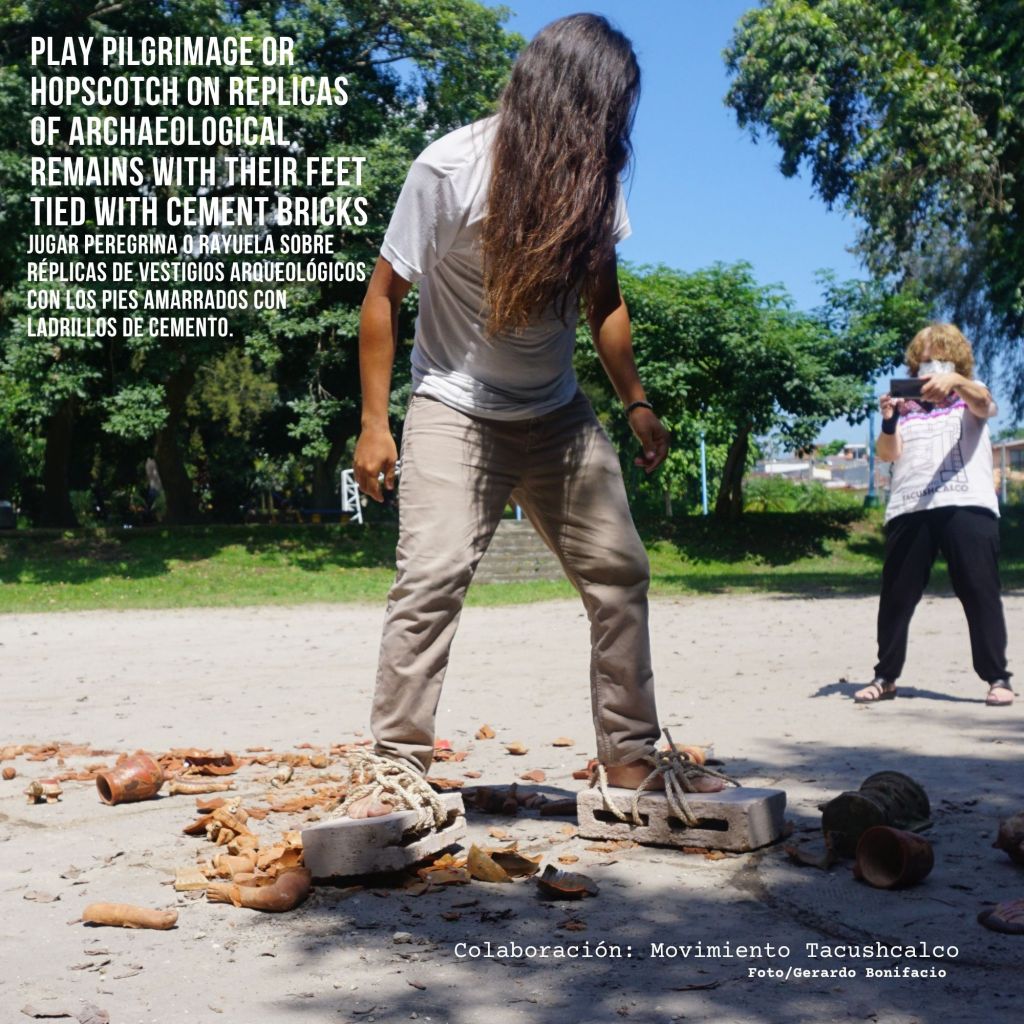
Crack Rodríguez reinterpreta el juego infantil conocido como “peregrina” o “rayuela” en un ritual performativo donde lo lúdico se convierte en crítica cultural. En lugar de simples cuadros trazados en el suelo, la figura del juego se dibuja con azúcar refinada —símbolo de la industria que devora territorios ancestrales—, mientras dentro de cada casilla se ubican réplicas de vestigios prehispánicos. El cuerpo del artista, con bloques de cemento atados a los pies como calzado de modernidad hostil, intenta desplazarse por esta ruta sagrada, esquivando lo imposible de esquivar: la memoria.
En las reglas tradicionales del juego, uno solo puede avanzar si el espacio está vacío. Pero aquí todos los espacios están habitados: por historia, por ruina, por herencia. La acción cuestiona la negación de las raíces indígenas y la violencia estructural que permite la destrucción de sitios como Tacushcalco, casa de las armas, hoy desarmada frente a la expansión constructora y cañera.
Peregrinaje se convierte en un acto de denuncia donde el avance se da a costa del peso, la torpeza y el irrespeto. Saltar no es progreso, sino repetición del daño. El artista, al usar ladrillos como calzado, encarna la paradoja del desarrollo: caminar sobre lo que deberíamos proteger. La memoria no desaparece; se pisa, se erosiona, se dulcifica y se entierra, mientras los vestigios se resisten a ser olvidados.
Pilgrimage
“Playing and jumping over the ruins of a mental puddle”
Crack Rodríguez – El Salvador
Crack Rodríguez reinterprets the childhood game known as peregrina or rayuela (hopscotch) as a performative ritual in which play becomes cultural critique. Instead of simple squares drawn on the ground, the game’s grid is traced with refined sugar—symbolizing an industry that consumes ancestral territories—while replicas of pre-Hispanic artifacts occupy each square. With concrete blocks tied to his feet as shoes of a hostile modernity, the artist attempts to move through this sacred path, trying to avoid the one thing that cannot be avoided: memory.
According to the traditional rules of the game, one can only advance when a space is empty. Here, however, every space is occupied—by history, ruins, and heritage. The action questions the denial of Indigenous roots and the structural violence that enables the destruction of sites such as Tacushcalco, “house of weapons,” now disarmed before the expansion of construction and the sugar industry.
Pilgrimage becomes an act of denunciation in which progress comes at the cost of weight, clumsiness, and disregard. Jumping is not progress, but a repetition of damage. By wearing bricks as shoes, the artist embodies the paradox of development: walking upon what we should be protecting. Memory does not disappear; it is stepped on, eroded, sweetened, and buried, while the remains resist being forgotten.


Deja un comentario