“División del Espíritu”
Crack Rodríguez, El Cafetalón, Santa Tecla, 2019, Texto Curatorial por The Fire Theory
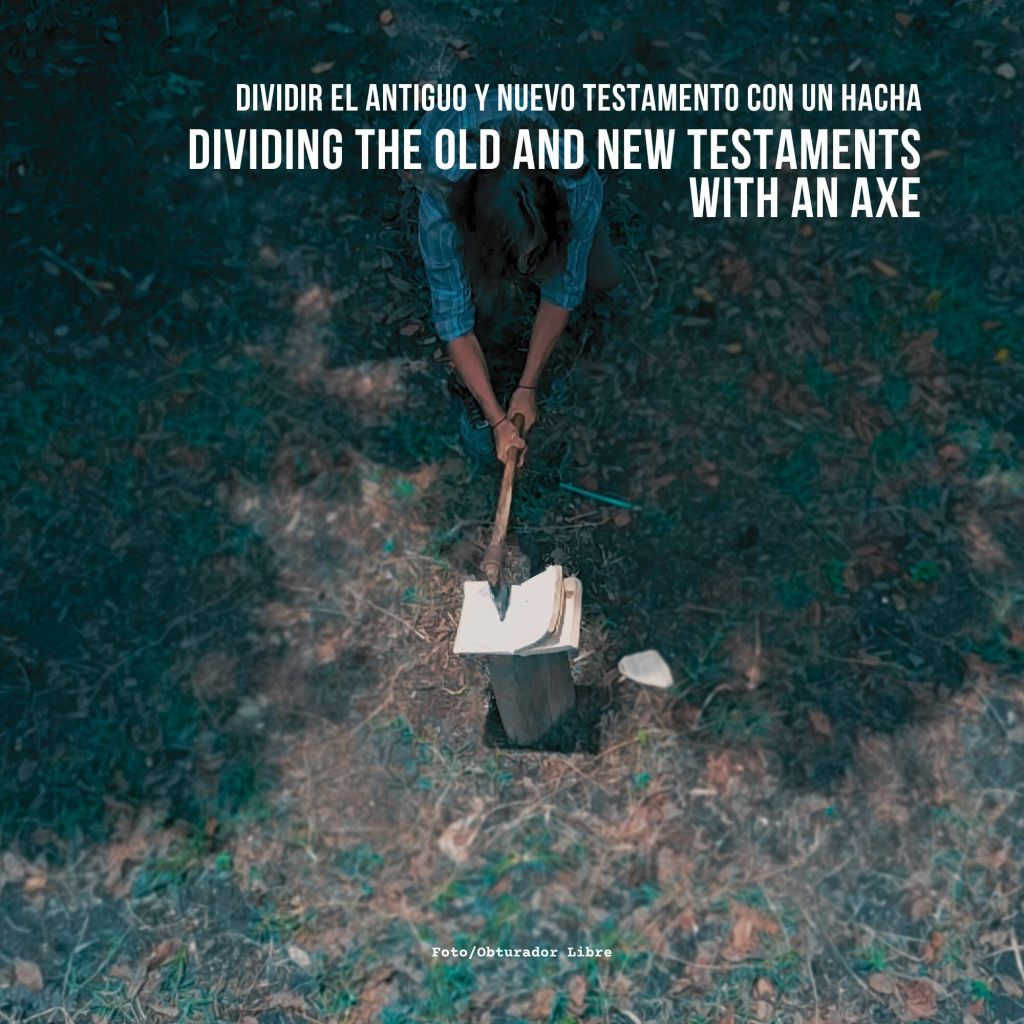
Entre árboles que resisten como últimos testigos de un territorio en constante amenaza, Crack Rodríguez se posiciona con un hacha en mano frente a una Biblia. No se trata de cualquier objeto: es el libro más reproducido, leído y manipulado del mundo, cargado de simbolismo, poder moral y estructuras de fe. Su gesto es sencillo, casi absurdo: intenta partirla en dos. Separar el Antiguo del Nuevo Testamento. Dividir el espíritu.
Entre los pocos árboles que aún sobreviven en el centro recreativo El Cafetalón, Crack Rodríguez se ubica con un hacha frente a una Biblia. No es un gesto impulsivo, sino un acto ritual cargado de intención: separar el Antiguo del Nuevo Testamento. Fragmentar el espíritu. Romper el símbolo sagrado en dos mitades que, aunque narrativamente diferenciadas, han sido históricamente impuestas como unidad indivisible en el imaginario judeocristiano.
La Biblia, sostenida sobre un trozo de madera cilíndrico —el clásico tajo donde se cortan leños—, se convierte en víctima y altar. La escena recuerda a un sacrificio. No el ofrecido a una deidad, sino el dirigido contra la hegemonía de un discurso que ha legitimado siglos de opresión, colonialismo y moralismo. A pesar de su inexperiencia con el hacha, Crack insiste: cada intento es una lucha entre cuerpo, herramienta e ideología. La resistencia de las páginas, la torpeza del gesto, y la repetición forzada del corte generan una tensión performática que desenmascara la violencia simbólica contenida en el acto.
Finalmente, la Biblia se divide. El corte se consuma. Crack deja el hacha, como quien abandona un crimen, y se retira en silencio del sitio de la herejía. Lo que queda es una imagen contundente: el libro abierto, partido, separado en dos cuerpos doctrinales; el altar de madera, testigo de la transgresión; y un vacío, un silencio denso, que interroga la sacralidad de lo intocable.
Este gesto puede leerse como un acto de artivismo radical dentro del panorama del arte político latinoamericano contemporáneo, donde la acción simbólica desarticula dispositivos de poder cultural. Crack Rodríguez dialoga con prácticas críticas del arte brasileño —como las de Cildo Meireles, que convirtió objetos religiosos en armas conceptuales— y se inserta en una genealogía de artistas que han confrontado los vínculos entre religión, violencia y Estado desde el cuerpo y el objeto.
Además, la obra opera como metáfora de la deforestación material y espiritual. En un país asediado por la tala indiscriminada, los intereses inmobiliarios y el abandono institucional, cortar una Biblia sobre un tajo de madera remite tanto al sacrificio de la naturaleza como al desgaste de la fe pública. El gesto —poético, doloroso, irreverente— denuncia el deterioro de las estructuras simbólicas que alguna vez prometieron consuelo y justicia.
«Cortar el Espíritu» no propone una destrucción gratuita, sino una interpelación profunda sobre lo que merece ser dividido, cuestionado y resignificado. La Biblia partida, lejos de ser solo un acto de blasfemia, se convierte en un manifiesto visual sobre la necesidad de escindir lo sagrado del poder, y de separar la redención verdadera de los discursos que la usurpan..
“The division of the Spirit”
Crack Rodríguez, El Cafetalón, Santa Tecla, 2019, curatorial text by The Fire Theory
Amidst the few surviving trees of the public recreation space El Cafetalón, Crack Rodríguez stands before a Bible with an axe in hand. This is not a spontaneous gesture, but a deliberate ritual — an act of rupture: to separate the Old and New Testaments, to divide the spirit. It is a symbolic dismemberment of a sacred object that, although narratively bifurcated, has historically been imposed as an indivisible ideological monolith across Latin America.
The Bible rests on a cylindrical block of wood — the kind used to chop firewood — turning the scene into both altar and execution site. The image evokes sacrifice, but not one made to a divine entity; rather, a challenge to the discursive violence legitimized through centuries of moral, religious, and colonial imposition. Despite his inexpert handling of the axe, Rodríguez persists. The awkwardness of his gestures, the resistance of the paper, and the laborious rhythm of each strike form a slow, painful choreography that lays bare the raw friction between body, tool, and dogma.
Eventually, the Bible is cleaved in two. The act is fulfilled. Rodríguez sets down the axe — as if walking away from a crime — and quietly leaves the site of heresy. What remains is a split book: doctrine divided into two doctrinal bodies; the chopping block as mute witness; and a heavy silence that lingers in the space, provoking questions about the sanctity of what is deemed untouchable.
This performance functions as radical artivism within the broader framework of contemporary Latin American political art, where symbolic gestures dismantle entrenched systems of power. Rodríguez’s work resonates with Brazilian conceptual strategies — evoking artists like Cildo Meireles, who transformed religious and ideological objects into subversive conceptual artifacts — and situates itself in a lineage of artistic practices that confront the intersections of faith, violence, and governance through the body and material culture.
At the same time, the piece acts as a metaphor for both environmental and spiritual deforestation. In a country plagued by indiscriminate tree felling, real estate greed, and institutional silence, chopping a Bible atop a log becomes a poetic indictment — a merging of ecological and theological critique. The performance confronts the decay of symbolic structures that once promised justice, comfort, and guidance.
«To Cut the Spirit» does not propose gratuitous destruction, but rather a profound inquiry into what deserves to be divided, questioned, and reimagined. The split Bible is not merely an act of sacrilege; it is a visual manifesto on the urgency of separating the sacred from the apparatus of power — of distinguishing redemption from domination.


Deja un comentario