La Trinidad
“Procesión para una República Empapada”
Crack Rodríguez – Boulevard Monseñor Romero, El Salvador, 2016, texto curatorial por The Fire Theory
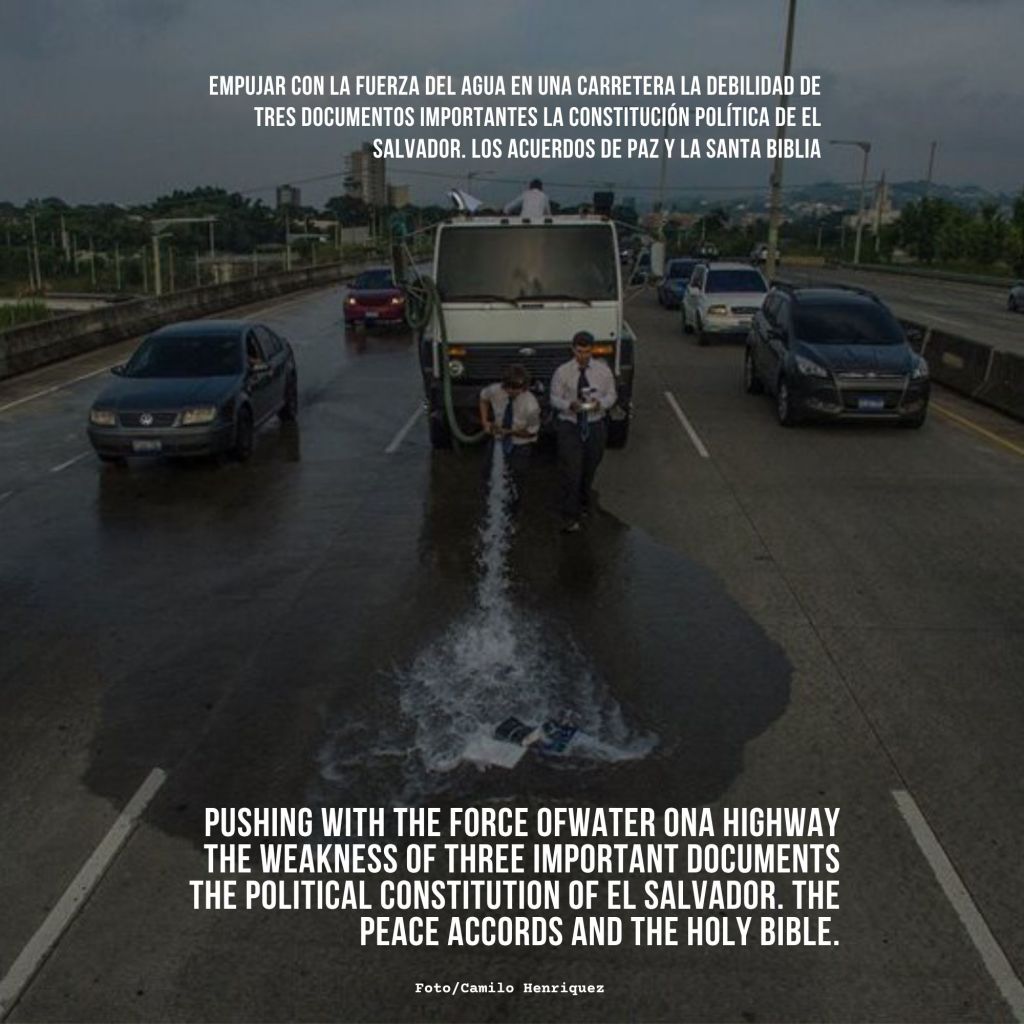
En pleno Boulevard Monseñor Romero, a la altura de la intersección con la calle Jerusalén, Crack Rodríguez y su equipo ralentizan el tránsito con un gesto inesperado: una procesión hidráulica en la que tres libros —La Santa Biblia, la Constitución de la República y los Acuerdos de Paz— son arrastrados por un chorro constante de agua sobre el asfalto.
Sostenida con torpeza deliberada, la manguera de una pipa vehicula no solo el movimiento de los libros, sino una crítica urgente: esos textos fundacionales, sagrados y políticos, han sido sistemáticamente ignorados o vaciados de contenido en la vida cotidiana salvadoreña. La acción no bloquea el tráfico, pero lo interrumpe sutilmente; como una liturgia civil involuntaria, los automovilistas aminoran la marcha y atestiguan la coreografía de un país que arrastra sus principios con indiferencia.
Desde el carril auxiliar hasta el centro de la carretera, los libros flotan y se empapan, resistiendo su tránsito entre el simbolismo y la saturación. Mientras una bandera blanca ondea en lo alto como pedido de paz o tregua simbólica, el desperdicio de agua —un bien escaso y disputado en el país— dialoga con la erosión institucional y el desgaste de los ideales que supuestamente sostienen la nación.
La Trinidad es una acción ritual que convierte la vía pública en pasaje teológico y político, donde fe, ley y reconciliación son arrastradas por la corriente. La intervención finaliza cuando el agua se agota: sin flujo, no hay fe, ni pacto, ni Constitución que avance. Rodríguez recoge los libros mojados, cruza de nuevo la calle y deja atrás la escena: un país empapado en símbolos que ya no logran avanzar por sí solos.
The Trinity
“Procession for a Soaked Republic”
Crack Rodríguez – Monseñor Romero Boulevard, El Salvador, 2016, curatorial text by The Fire Theory
At the Monseñor Romero Boulevard, near the intersection with Jerusalem Street, Crack Rodríguez and his collaborators slow traffic through an unexpected gesture: a hydraulic procession in which three books—The Holy Bible, the Constitution of the Republic, and the Peace Accords—are dragged across the asphalt by a continuous stream of water.
Held with deliberate awkwardness, the hose becomes more than a mechanism for moving the books; it becomes a vehicle for urgent critique. These foundational sacred and political texts have been systematically ignored or emptied of meaning within everyday Salvadoran life. The action does not block traffic, but subtly disrupts it; like an involuntary civic liturgy, drivers slow down and witness the choreography of a country dragging its principles forward with indifference.
From the auxiliary lane toward the center of the road, the books float and become soaked, caught between symbolism and saturation. Above them, a white flag signals a request for peace or symbolic truce, while the waste of water—a scarce and contested resource in El Salvador—echoes institutional erosion and the exhaustion of the ideals supposedly sustaining the nation.
The Trinity transforms the public roadway into a theological and political passage, where faith, law, and reconciliation are carried away by the current. The intervention ends when the water runs out: without flow, there is no ritual, no pact, no Constitution capable of moving forward. Rodríguez gathers the soaked books, crosses back toward the auxiliary lane, and leaves the scene behind—a country drenched in symbols that can no longer move forward on their own.


Deja un comentario